Table Of Content
As a hypothetical example, imagine that a researcher wants to know how the independent variables of income and health relate to the dependent variable of happiness. This is tricky because income and health are themselves related to each other. Thus if people with greater incomes tend to be happier, then perhaps this is only because they tend to be healthier.
Statology Study
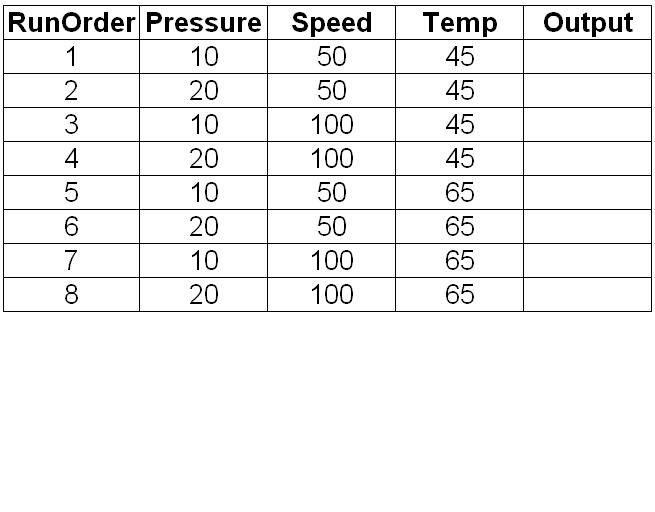
As seen in the table, the values of the main total factorial effect are 0 for A, B, and AB. This proves that neither dosage or age have any effect on percentage of seizures. If an investigator decides to use a factorial design, s/he has numerous choices to make, including choices about the number and types of factors to include. This framework can be generalized to, e.g., designing three replicates for three level factors, etc. The columns for A, B and C represent the corresponding main effects, as the entries in each column depend only on the level of the corresponding factor. For example, the entries in the B column follow the same pattern as the middle component of "cell", as can be seen by sorting on B.
A microfluidic optimal experimental design platform for forward design of cell-free genetic networks - Nature.com
A microfluidic optimal experimental design platform for forward design of cell-free genetic networks.
Posted: Fri, 24 Jun 2022 07:00:00 GMT [source]
Main Effects
This can pose interpretive challenges as it may be difficult to separate the effects of a component per se from the impact of burden. Shows how each level of one independent variable is combined with each level of the others to produce all possible combinations in a factorial design. In a Factorial Design of Experiment, all possible combinations of the levels of a factor can be studied against all possible levels of other factors. Therefore, the factorial design of experiments is also called the crossed factor design of experiments. Due to the crossed nature of the levels, the factorial design of experiments can also be called the completely randomized design (CRD) of experiments. Therefore, the proper name for the factorial design of experiments would be completely randomized factorial design of experiments.
Factorial Designs
Simultaneous examination of multiple factors at two levels can reveal which have an effect. Researchers want to determine how the amount of sleep a person gets the night before an exam impacts performance on a math test the next day. But the experimenters also know that many people like to have a cup of coffee (or two) in the morning to help them get going. For example, imagine that researchers want to test the effects of a memory-enhancing drug. Participants are given one of three different drug doses, and then asked to either complete a simple or complex memory task.

Next, look at the effect of being tired only for the “5 hour” condition. We see the red bar (tired) is 3 units lower than the green bar (not tired). So, there is an effect of 3 units for being tired in the 5 hour condition. Clearly, the size of the effect for being tired depends on the levels of the time since last meal variable.

From this one can see that there is an interaction effect since the lines cross. One cannot discuss the results without speaking about both the type of fertilizer and the amount of water used. Using fertilizer A and 500 mL of water resulted in the largest plant, while fertilizer A and 350 mL gave the smallest plant. Fertilizer B and 350 mL gave the second largest plant, and fertilizer B and 500 mL gave the second smallest plant. There is clearly an interaction due to the amount of water used and the fertilizer present.
It looks at the size of the effects and plots the effect size on a horizontal axis ranked from largest to smallest effect. Once you have these contrasts, you can easily calculate the effect, you can calculate the estimated variance of the effect and the sum of squares due to the effect as well. I have a Master of Science degree in Applied Statistics and I’ve worked on machine learning algorithms for professional businesses in both healthcare and retail. I’m passionate about statistics, machine learning, and data visualization and I created Statology to be a resource for both students and teachers alike. My goal with this site is to help you learn statistics through using simple terms, plenty of real-world examples, and helpful illustrations. This is less clear because the effect is smaller so it is harder to see.
Just as it is common for studies in education (or social sciences in general) to include multiple levels of a single independent variable (new teaching method, old teaching method), it is also common for them to include multiple independent variables. As we will see, interactions are often among the most interesting results in empirical research. In sum, in a factorial experiment, the effects, relative effects, and statistical significance of ICs will likely change depending upon the number and types of components that co-occur in the experimental design. This arises, in part, from the fact that the effects of any given factor are defined by its average over the levels of the other factors in the experiment. It is important, therefore, for researchers to interpret the effects of a factorial experiment with regard to the context of the other experimental factors, their levels and effects. This does not reflect any sort of problem inherent in factorial designs; rather, it reflects the trade-offs to consider when designing factorial experiments.
Fractional Factorial Experiments
Rather, there is an interaction effect between the two independent variables. Main effects occur when the levels of an independent variable cause change in the measurement or dependent variable. There is one possible main effect for each independent variable in the design. When we find that independent variable did influence the dependent variable, then we say there was a main effect.
The point of this example is that although the B factor is not significant as it relates to the response, percentage of product defects - however if you are looking for a recommended setting for B you should use the low level for B. However, by choosing B at the low level you will produce a more homogeneous product, products with less variability. What is important in product manufacturing is not only reducing the number of defects but also producing products that are uniform. This is a secondary consideration that should be taken into account after the primary considerations related to the percent of product defects. Is there always a transformation that can be applied to equalize variance?
Interactions occur when the effect of an independent variable depends on the levels of the other independent variable. As we discussed above, some independent variables are independent from one another and will not produce interactions. However, other combinations of independent variables are not independent from one another and they produce interactions. Remember, independent variables are always manipulated independently from the measured variable (see margin note), but they are not necessarilly independent from each other. Factorial designs require the experimenter to manipulate at least two independent variables. Imagine you are trying to figure out which of two light switches turns on a light.
A 2 × 2 factorial design has four conditions, a 3 × 2 factorial design has six conditions, a 4 × 5 factorial design would have 20 conditions, and so on. Also notice that each number in the notation represents one factor, one independent variable. So by looking at how many numbers are in the notation, you can determine how many independent variables there are in the experiment. 2 x 2, 3 x 3, and 2 x 3 designs all have two numbers in the notation and therefore all have two independent variables. The numerical value of each of the numbers represents the number of levels of each independent variable. A 2 means that the independent variable has two levels, a 3 means that the independent variable has three levels, a 4 means it has four levels, etc.
Thus, there must be an interaction effect between the dosage of CureAll, and the age of the patient taking the drug. When you have an interaction effect it is impossible to describe your results accurately without mentioning both factors. You can always spot an interaction in the graphs because when there are lines that are not parallel an interaction is present. If you observe the main effect graphs above, you will notice that all of the lines within a graph are parallel.
In the second study, participants were randomized to a combination of light plus cognitive behavioral therapy or sham light therapy plus cognitive behavioral therapy. The main outcomes were self-reported sleep times, momentary ratings of evening sleepiness, and subjective measures of sleepiness and sleep quality. But the two 2-way interactions effects combined are no longer significant, and individually, the interactions are not significant here either. So, the log transformation which improved the unequal variances pulled the higher responses down more than the lower values and therefore resulted in more of a parallel shape. Now we are in a position where we can drop the interactions and reduce this model to a main effects only model. You can see that the C and D interaction plot the lines are almost parallel and therefore do not indicate interaction effects that are significant.
It would also be possible to represent cell phone use on the x-axis and time of day as different-colored bars. The choice comes down to which way seems to communicate the results most clearly. The bottom panel of Figure 5.3 shows the results of a 4 x 2 design in which one of the variables is quantitative. This variable, psychotherapy length, is represented along the x-axis, and the other variable (psychotherapy type) is represented by differently formatted lines. This is a line graph rather than a bar graph because the variable on the x-axis is quantitative with a small number of distinct levels. Line graphs are also appropriate when representing measurements made over a time interval (also referred to as time series information) on the x-axis.


No comments:
Post a Comment